
February 25, 2022
What are the top digital trends of 2022?
Which trends in digital communication could take center stage in 2022? Partly "novelties", partly evergreen practices that always help you find and retain your audience.

Which trends in digital communication could take center stage in 2022? Partly "novelties", partly evergreen practices that always help you find and retain your audience.
Simplifying the user experience (UX)
Making the customer experience simpler, whatever product or service we sell, should be a priority. It is necessary to acquire new customers and retain those who already are, not by inertia but because they appreciate what we do.
Since smartphones became indispensable for almost every generation of consumers, for at least a decade, it has been necessary to design user experience with a mobile-first approach, thinking first about phones: they are the first device from which people browse the internet, shop, and watch or listen to streaming content.
Especially for e-commerce, a category for which it is easy to identify a final conversion, the purchase, it is essential that the experience, from browsing the platform to finding an idea to filling the cart, be as intuitive and frictionless as possible. Attention should therefore focus on:
- the user interface, essential but complete;
- the first access or registration process, which must be frictionless but must also ask the user for all the data we need for our purposes;
- features that enable purchase or similar actions (adding an item to the cart or a wish list), so they are clearly visible;
- site "lightness": a page that loads in a few milliseconds is now a baseline expectation, and even a couple of seconds of delay could mean a lost customer or prospect;
- subscription mechanisms, to make recurring purchases fully automatic. Not only for digital products like music, films, TV series, and software, for which this has been routine for at least a decade: the subscription economy applies to physical products too, as Amazon shows, for example.
A virtuous example of all this can be found in a project by one of the world's best-known guitar makers, Fender.
Fender Play
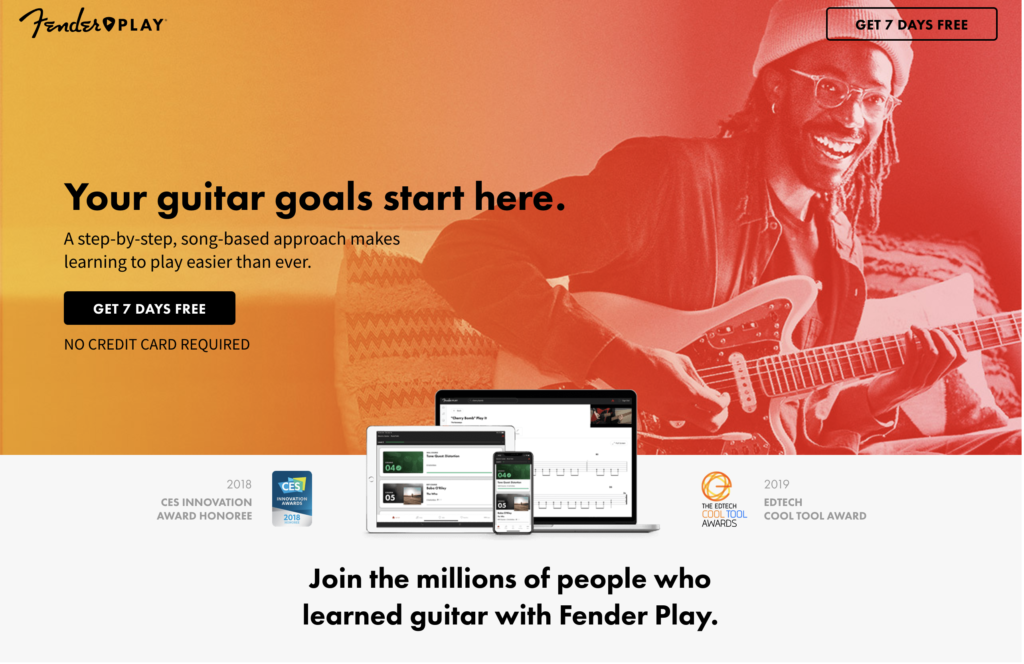
Fender Play is an app for learning to play guitar: the platform gives access to courses taught by professional musicians, suitable even for those who have never picked up an instrument before.
The landing page is structured as follows:
- at the top is the value proposition: "Your guitar goal starts here", against the background of someone playing one of the American brand's most iconic models (which one isn't?);
- a classic but hard-to-resist CTA offering a free week trial;
- a series of other elements aimed at making us feel immediately part of a community, from the number of hours students have spent studying to their testimonials.
In this way, a "plain" app subscription becomes entry to an exclusive club made up of people with the same interests. A membership.

Leveraging 3D and augmented reality
In the world of 3D (real and virtual) and augmented reality, we are no longer in a prototype phase: the technology is ready to offer people interactive experiences that are more than satisfactory, and we are not talking only about graphical interfaces.
Those working in apparel, for example, could structure their site or app so it interacts live with the physical store: if I frame a garment with my smartphone, or approach a screen with a webcam, I can discover details like price, colors, and product availability on my own, or try items on directly. As Sephora, Dior, and Tissot do.
Outside retail too, VR potential is vast: how interesting would it be to walk the streets of Pompeii still standing?

Investing in video
Video is among the formats that, when designed with care, guarantee a higher engagement and interaction rate than average, and not only because social network algorithms reward it.
What attracts us about video is that reality unfolds before our eyes, even when recorded. Presenting a product in video with unboxing, or telling a brand story ironically through an influencer challenge on TikTok, can make the difference between a good product that sells well and a good product that does not sell enough.
What we look for in video, however, is also something else: informative and educational content that is easy to consume and above all practically useful. Tutorials, infographics that make learning feel pop; long formats too (journalistic longform, for example) that are not just a block of text but integrated with small interactive experiences, thematic microsites within your own domain.
In brief, leverage digital potential without limiting yourself to reproducing "old media" content in stagnant compartments: video, text, and non-interactive images.

Creating content we would want to find
How often do we skip content because it does not attract us or puts us off, but when it is our turn to produce it we make the same mistakes we noticed in others' work?
A way out of this vicious circle exists and is less obvious than it may seem: design content carefully and choose a framework, a guide that gradually becomes absorbed and spontaneous. As often happens, Google simplifies life for content producers and proposes the EAT formula: Expertise, Authoritativeness, Trustworthiness.
In detail, EAT represents the system by which Google judges content quality and the guidance for producers to best respect people's search intent. In brief, pages and content must be useful.
What exactly does "useful" mean?
- Who creates the content must have specific experience and expertise to speak about it, experience that must align with the purpose of the content, as SEOZoom explains well;
- from this derives (or should derive) authoritativeness, which passes above all through external recognition, such as the quantity of links and mentions;
- closely connected is therefore trustworthiness, which takes above all the quality of external recognition into account.
EAT, therefore, represents a complex path that delivers results over the long term, just like SEO work: build a well-defined identity and become a reference point through daily work, writing quality content and periodically updating what has already been written, commenting on it and keeping it current based on elapsed time.

Toward the metaverse
We could describe the metaverse as the mature form of virtual and augmented reality, where however the world we know is not simply enhanced by digital architectures but replaced by its internet counterpart, fully autonomous. A somewhat more mature Second Life. Whatever the most fitting definition, the metaverse will likely develop and endure, as social media and all the communication media we have known in the past have done. How, then, should we behave to leverage this opportunity wisely?
Study it first, understand whether and how it could truly be useful to your business, and avoid the mistake of treating it as a bizarre or meaningless novelty. Ask questions such as:
- Is my target, or could it be, interested in the metaverse?
- How could I adapt or naturally integrate my commercial activity into this parallel universe?
A brand like Fender, for example, could recreate a virtual environment where musicians and aspiring musicians meet, tell its story, recreate "live" concerts by famous Fender guitarists of the past, or let customers pretend to be them, like in a live-action role-playing game.
Like the metaverse, topics such as digital art, NFTs, or cryptocurrencies may seem ridiculous to those who are not passionate about them or do not grasp their commercial opportunities, just as 15 years ago Facebook may have seemed only a game with no impact on everyday life. And yet today, the average age of Facebook users is not that low...
You might also like

June 11, 2026
Digital marketingSyncronika, from 2010 to 2026. What we have become and where we are heading
From Ferrara to Milan, from software house to a product ecosystem for European businesses: product, system integration, and the EU market. Syncronika's vision for the years ahead.
Read article
April 28, 2026
Artificial intelligenceSyncronika, AI, and the future of digital: why we are evolving beyond the classic agency
AI does not replace the need for governance, integration, and control. Syncronika is evolving from agency and software house to digital factory: AgenVIO, Complyo, and consulting on the same ecosystem.
Read article
March 14, 2026
Digital marketingDigital communication and marketing agency in Milan: how to choose the right partner
A marketing agency in Milan must be able to work on multiple levels: strategy, communication, digital platforms, and data.
Read article